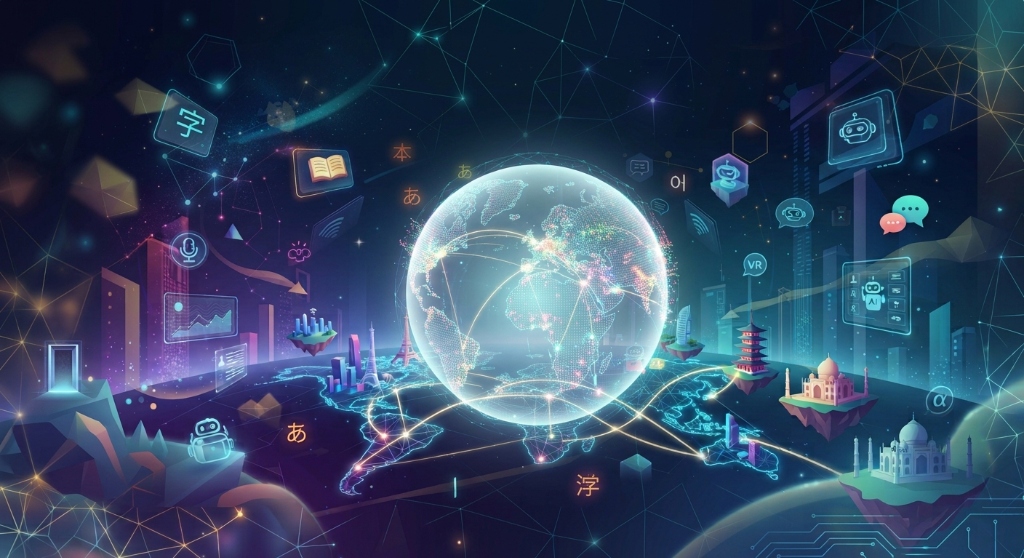
The Future of ESL Education: Multimodal AI, Spatial Computing, and Gamified Virtual Worlds
The Century-Long Stagnation of Language Classrooms
If a physician from 1885 were miraculously transported into a modern hospital surgical theater, they would be utterly baffled by the robotic laparoscopy arms, MRI scanners, and pulse oximeters. The medical field has undergone multiple revolutionary paradigm shifts.
Yet, if a schoolteacher from 1885 were transported into an average 2026 language classroom, they would feel instantly at home. Aside from the blackboard transitioning from slate to an interactive projector, the foundational architecture remains virtually unchanged: twenty-eight students sitting in rows, listening to a single instructor lecture from a standardized textbook, completing fill-in-the-blank worksheets, and taking a standardized written test on Friday.
This industrial-era model was engineered for conformity and mass processing, not for dynamic linguistic acquisition. Human language is not an academic subject like trigonometry or historical dates; **language is an embodied, social, adaptive survival technology**. You do not learn to swim by reading a textbook about water density; you learn to swim by jumping into the pool.
We are currently standing at the threshold of the greatest revolution in educational history: the convergence of **Generative Artificial Intelligence**, **Spatial Computing**, and **Gamified Virtual Metaverse Architecture**.
Pillar 1: Infinite, Non-Judgmental Conversational AI
Historically, the single greatest bottleneck in language learning was access to native speakers. Hiring a qualified 1-on-1 native tutor costs between twenty and fifty dollars per hour—a financial barrier that excludes 95% of the global population.
Large language models and real-time speech synthesis have completely shattered this economic wall:
Pillar 2: Spatial Embodiment and Contextual Encoding
Cognitive psychology demonstrates that memories formed within rich spatial environments are retained up to **four times longer** than memories memorized from flat 2D flashcards. This is known as **context-dependent memory**.
When you study English vocabulary inside an immersive space station:
Pillar 3: Algorithmic Scaffolding and Invisible Assessment
In the traditional education paradigm, assessment is an intrusive, anxiety-inducing event: class stops, desks are cleared, and a high-stakes exam paper is distributed.
In the future of gamified learning, **assessment is invisible and continuous**:
The Teacher's Evolving Role: From Lecturer to Flight Commander
Does this technological revolution render human teachers obsolete? Absolutely not. In fact, it elevates the teaching profession to its highest historical potential.
When automated AI systems handle the repetitive, tedious labor of vocabulary drills, worksheet grading, and pronunciation waveform tracking, teachers are liberated from administrative exhaustion:
The Galactic Vision of LingoLandVerse
At LingoLandVerse, we believe that fluent English communication is not a luxury reserved for those who can afford elite private academies. It is a universal human bridge that connects diverse minds, dismantles cultural prejudice, and unlocks global professional opportunities.
By fusing rigorous cognitive science with the boundless wonder of interstellar exploration, we are building a universe where every student on Earth can unlock their fullest voice and pilot their own destiny among the stars.